
Contents

11th JLPP International Translation Competition
  1. ホーム
  2. 翻訳コンクール
  3. 11th JLPP International Translation Competition
11th JLPP International Translation Competition

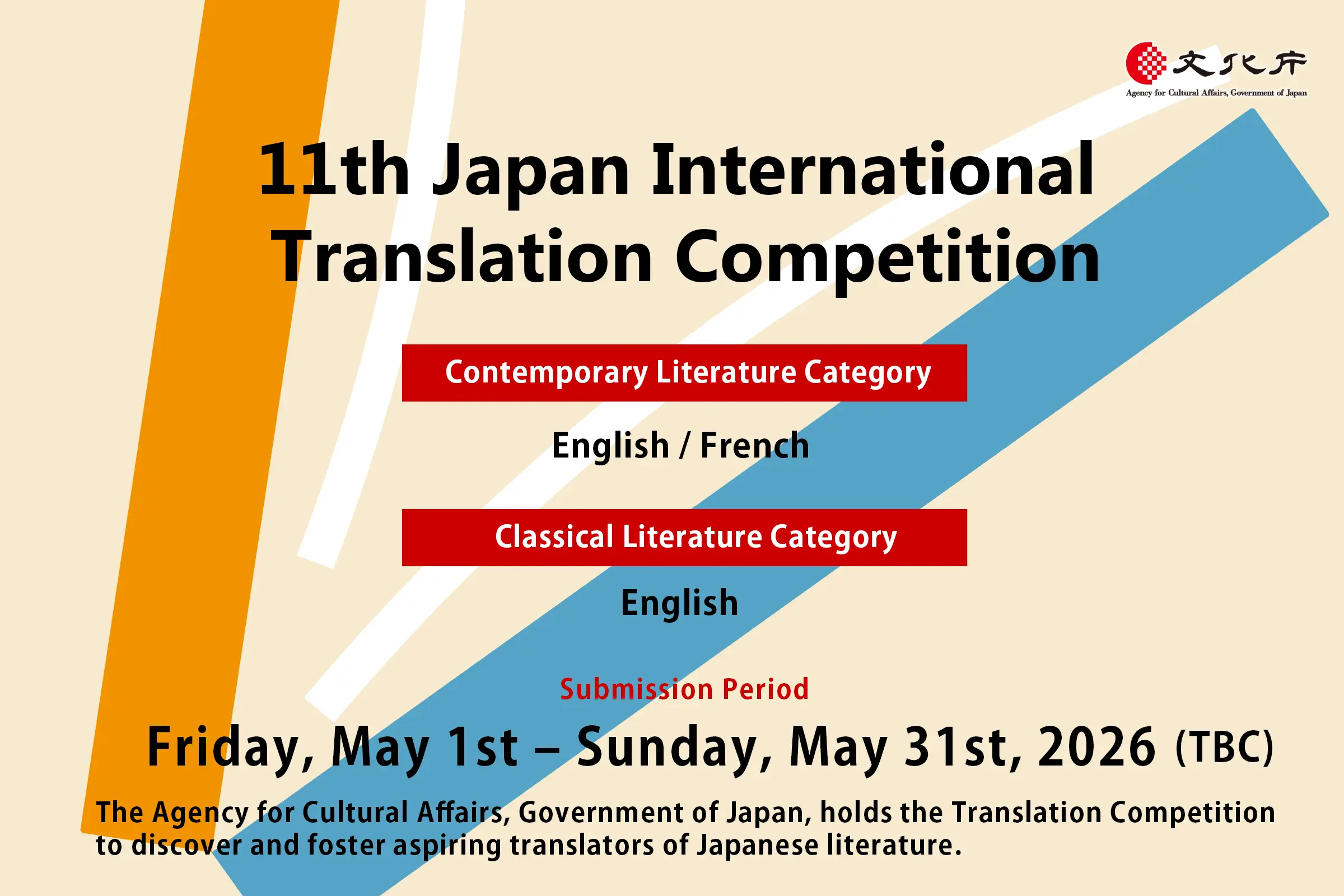
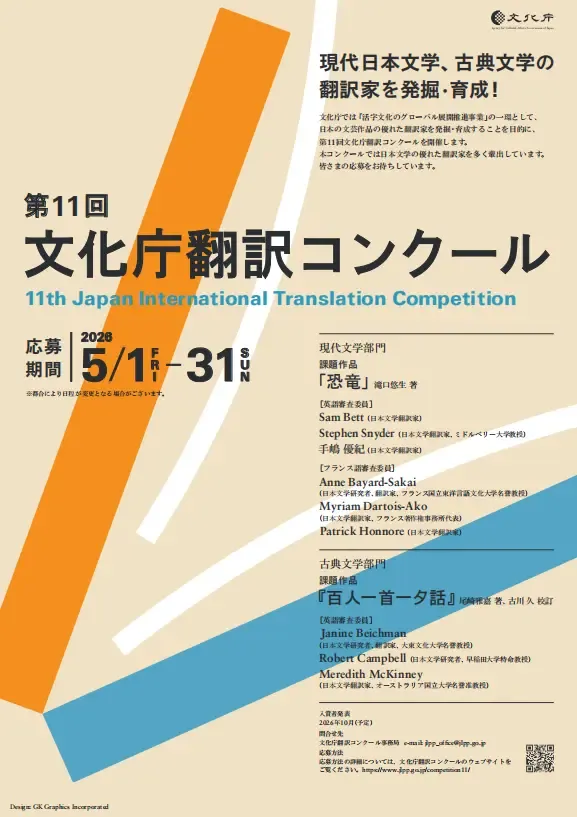
The Agency for Cultural Affairs, Government of Japan, is delighted to hold the 11th JLPP International Translation Competition, aimed at discovering and fostering aspiring translators of contemporary Japanese literature. In the 11th Competition, the contemporary literature category accepts translations into English and French, while the classical literature category accepts translations into English only.
Entries for the 11th JLPP International Translation Competition are closed.

Source Text

Contemporary Literature Category

Source text cover

“Kyoryu”

Fiction

by TAKIGUCHI Yusho

Biography of Author

TAKIGUCHI Yusho

Novelist

Born in Tokyo in 1982, TAKIGUCHI Yusho debuted in 2011 by winning the Shincho Prize for New Writers for Gakki. In 2015, he received the Noma Literary Prize for New Writers for Ai to Jinsei ; in 2016, the Akutagawa Prize for Shinde Inai Mono ; in 2022, the Oda Sakunosuke Prize for Suiheisen ; in 2023, the Minister of Education, Culture, Sports, Science and Technology’s Art Encouragement Prize for the same work; and that same year, the Kawabata Yasunari Literary Prize for Hantai Hoko Yuki. His other works include Nezo, Jimi Hendricks Experience, Nasu no Kagayaki, Kokasen, Yagate Wasureru Katei no Tochu (Iowa Nikki), Nagai Ichinichi, Ramen Curry, and Sabishisa ni tsuite (co-authored with UEMOTO Ichiko).

Classical Literature Category

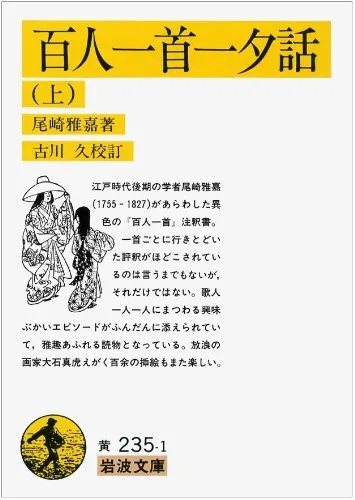
Source text cover

“Hyakunin Isshu Hitoyogatari”

by OZAKI Masayoshi, edited by FURUKAWA Hisashi

Biography of Author

OZAKI Masayoshi (1755 – 1827)

Scholar of Japanese Literature

OZAKI Masayoshi was born in Settsu Province, in Osaka (present-day Osaka City). He studied Confucianism under OKUDA Shosai before turning to Kokugaku through the works by Keichu. He later authored and published numerous works that integrated Kokugaku and Confucianism. He also maintained close associations with waka poets and literati, including KIMURA Kenkado and members of the Kagawa Kageki school.
His representative work, Hyakunin Isshu Hitoyogatari, was published posthumously in 1833. This work offers detailed accounts of the poets featured in the Hyakunin Isshu, drawing on waka poetry and a wide range of historical and literary sources.

FURUKAWA Hisashi (1909 – 1994)

Scholar of Japanese literature; Professor Emeritus at Tokyo Woman’s University

Born in Nagoya, Aichi Prefecture, FURUKAWA Hisashi graduated from the Department of Japanese Literature at Tohoku Imperial University. While teaching at universities, he also served as a researcher at the Nogami Memorial Noh Theatre Research Institute of Hosei University. His personal library is preserved at the Hosei University Library as the Furukawa Collection. In support of his mentor, KOMIYA Toyotaka, he contributed to the editing of the postwar Iwanami Shoten edition of Soseki Zenshu, while also pursuing his own research on NATSUME Soseki. His major publications include Meiji Nohgaku-shi Josetsu (1969; Wanya Shoten) and Soseki no Shokan (1970; Tokyodo Shuppan). His notable edited and annotated works include the three-volume Nihon Koten Zensho: Kyogen-shu (1953–56; Asahi Shimbun) and OZAKI Masayoshi’s Hyakunin Isshu Hitoyogatari (1972; Iwanami Bunko), among many others.

Prizes

  • The winners of the Contemporary Literature category (English and French) and the Classic Literature category (English) will each receive a certificate, a trophy, and a cash prize (grand prize of 1,000,000 yen and second prize of 250,000 yen).
  • Winners will be contacted individually and posted on this website in October 2026 (TBC). The translations of the prize winners will also be posted on this website, along with the judges' observations on their work.
  • Winners will be invited to translator-development events, such as a translation workshop.

Judging Process

  1. Submission Period

    May 1st (Fri) - May 31st (Sun) 2026 (JST)

  2. Judging

    June – September 2026 (TBC)

  3. Winners Announced

    October 2026 (TBC)

  4. Award Ceremony

    December 2026 (TBC)

Overview

Submission Period Friday, May 1st - Sunday, May 31st, 2026 (JST)
Purpose The JLPP International Translation Competition aims to discover and foster translators essential to introducing Japanese literary works to the world.
Eligibility There are no nationality or age-related eligibility criteria. However, because the purpose of the competition is to foster the next generation of professional literary translators, those who have published book-length literary translations are not eligible, although translations published in magazines and/or anthologies are permissible. As an exception, in the classical literature category, applicants with experience in translating and publishing modern literature are also eligible.
Target Languages and Source Texts

【Contemporary Literature Category】
Target Languages : English / French
Source text : [Fiction] “Kyoryu” by TAKIGUCHI Yusho

【Classical Literature Category】
Target Language : English
Source text : “Hyakunin Isshu Hitoyogatari” by OZAKI Masayoshi, edited by FURUKAWA Hisashi

Application Procedure
  1. Applications are to be submitted via this website. After visiting the "11th JLPP International Translation Competition" section, click on the "Application Page" banner to proceed with your application. For details on the application procedure, please refer to the Application Page, which will be available starting May 1st, 2026. Please note that applications submitted via email will be disqualified.
  2. Applications submitted via any other methods will not be accepted.
  3. Translation manuscripts must be formatted on A4 or letter-sized paper, in portrait orientation, written horizontally, with approximately 32 lines per page (or double-spaced) using 12-point Times New Roman font, with left and right margins of at least 1.5 cm, specifying the “page number of total pages” on each page. Formatting discrepancies caused by differences in software will be selectively permitted. Files must be submitted as PDFs. When converting to PDF, please check for conversion errors and correct before submitting.
  4. The name of the translator must not appear anywhere on the submitted translations.
  5. Applications failing to comply with the above requirements will be disqualified, barring extenuating circumstances to be dealt with on a case-by-case basis.
Judging Process
  1. Judging will be conducted in two stages: a preliminary screening, followed by a meeting of the judging committee to review the shortlisted works and select the prize winners.
  2. The Grand Prize will be awarded, in principle, to one (individual) translator in each language in each category whose translation is considered to be of exceptionally high quality.
  3. Second Prizes will be awarded to no more than two translators in each language in each category whose translations are considered to be of very high quality.
  4. At the discretion of the judging committee, Honorable Mentions will be awarded to (individual) translators whose efforts show great promise, but are not considered to qualify for the Grand Prize or a Second Prize. The number of Honorable Mentions will not exceed the total of the Grand Prize and the Second Prizes.
  5. Those who have received the Grand Prize in past JLPP International Translation Competitions are not eligible for any prize.

Information on the Next (12th) Competition

The 12th JLPP International Translation Competition is scheduled to be held earlier than usual.
Further details, including the exact schedule, will be announced on this website and through other channels once they have been confirmed.


Judging Committee

Contemporary Literature Category

English

Sam Bett
©Danny Gugger

Sam Bett

Translator of Japanese Literature

View Profile
Stephen Snyder

Stephen Snyder

Translator of Japanese Literature, Professor of Japanese Studies, Interim President, Middlebury College

View Profile
TEJIMA Yuki

TEJIMA Yuki

Translator of Japanese Literature

View Profile
Sam Bett
©Danny Gugger

Sam Bett

Translator of Japanese Literature

Born in 1986. Graduated from UMass-Amherst, majoring in English and Japanese Language & Literature. In 2015, Sam was awarded Grand Prize in the 2nd JLPP International Translation Competition. His translation work includes the Katanagatari series by NISIOISIN, The Flowers of Buffoonery and The Beggar Student by Osamu Dazai, and The Rope Artist by Fuminori Nakamura. His translation of Star by Yukio Mishima won the 2019-2020 Japan-US Friendship Commission Prize. He also co-translated Mieko Kawakami's works with David Boyd, including Breasts and Eggs, Heaven, and All the Lovers in the Night. Heaven was shortlisted for the 2022 International Booker Prize. His translation of The Night of Baba Yaga by Akira Otani won the 2025 Dagger Award for Crime Fiction in Translation. Alongside his translation work, he is a co-host of Us&Them, a Brooklyn-based reading series showcasing the work of writers who translate.

Stephen Snyder

Stephen Snyder

Translator of Japanese Literature, Dean of Language Schools and Vice President for Academic Affairs; Professor of Japanese Studies, Interim President, Middlebury College

Born in 1957. Earned Ph.D. from Yale University. He is the author of Fictions of Desire: Narrative Form in the Novels of Nagai Kafu and co-editor of Oe and Beyond: Fiction in Contemporary Japan. He has translated contemporary Japanese novels by Yoko Ogawa, Kenzaburo Oe, Ryu Murakami, Yu Miri, Kotaro Isaka, to name a few. He also published his translation of Rivalry: A Geisha's Tale by Nagai Kafu and Ashura Girl by Otaro Maijo under JLPP. His translation of Memory Police by Yoko Ogawa was shortlisted for the 2019 National Book Award for Translated Literature and the 2020 International Booker Prize. Mina’s Matchbox., also by Yoko Ogawa, was selected as one of TIME’s 100 Must-Read Books of 2024 in his English translation.

TEJIMA Yuki

TEJIMA Yuki

Translator of Japanese Literature

TEJIMA Yuki was born in Tokyo and raised in Los Angeles from the age of four. A graduate of University of California, Irvine, Yuki worked for fifteen years in film, television and commercial translation in New York City and Tokyo before shifting to literary translation. Her translation work includes Lost Souls Meet Under a Full Moon and How to Hold Someone in Your Heart by Mizuki Tsujimura, Someone to Watch Over You by Kumi Kimura, When the Museum is Closed by Emi Yagi, Then Why Ask Me To Come? by Risa Wataya, and Totto-chan: The Little Girl at the Window The Sequel by Tetsuko Kuroyanagi. She was awarded Second Prize in the English category of the 5th JLPP International Translation Competition.

Classical Literature Category

English

Janine Beichman

Janine Beichman

Scholar and translator of Japanese Literature, Professor Emeritus at Daito Bunka University

View Profile
Robert Campbell

Robert Campbell

Scholar of Japanese Literature, University Professor, Waseda University

View Profile
Meredith McKinney

Meredith McKinney

Translator of Japanese literature, Honorary Associate Professor at the Australian National University

View Profile
Janine Beichman

Janine Beichman

Scholar and translator of Japanese Literature, Professor Emeritus at Daito Bunka University

Earned her doctorate from Columbia University, specializing in Japanese literature. Her publications include Masaoka Shiki: His Life and Works, Embracing the Firebird: Yosano Akiko and the Rebirth of the Female Voice in Modern Japanese Poetry, and Drifting Fires: An American Nō. Her translation of Ōoka Makoto's poems, Beneath the Sleepless Tossing of the Planets: Selected Poems received the Japan-U.S. Friendship Foundation's Japanese Literature Translation Award. Her recent translations include Well-Versed: Exploring Modern Japanese Haiku (“Meiku no yuen” by Minoru Ozawa) and This Overflowing Light: Rin Ishigaki Selected Poems.

Robert Campbell

Robert Campbell

Scholar of Japanese Literature, University Professor, Waseda University

Robert Campbell is a scholar of Japanese literature, Professor of Waseda University, Professor Emeritus at the University of Tokyo and former Director-General of the National Institute of Japanese Literature (NIJL). Born in New York City, he attended high school in San Francisco, studied in the Departments of Economics and Oriental Languages, University of California, Berkeley (B.A. 1981), and in the Department of East Asian Languages and Civilization, Graduate School of Fine Arts, Harvard University (M.A. 1984; Ph.D. 1992). In addition to writing, editing and contributing to numerous volumes on Japanese literature, art and drama, Robert is active in the Japanese media as television host, news commentator, newspaper columnist, book reviewer and radio personality.

Meredith McKinney

Meredith McKinney

Translator of classical, early modern, and contemporary Japanese Literature, Honorary Associate Professor at the Australian National University

Meredith McKinney earned her PhD in classical Japanese literature from the Australian National University. After living in Japan for around twenty years, she returned to Australia where she now lives near a small country town in New South Wales. She has published over twenty translations. These include classics such as The Pillow Book, Hōjōki and Essays in Idleness; Kokoro and Kusamakura by Natsume Sōseki; and works by modern writers Furui Yoshikichi, Shimada Masahiko and Tanabe Seiko. She won the Japan-US Friendship Commission Prize for Furui Yoshikichi's Ravine and Other Stories. A Tale Unasked, her translation of Towazugatari, was published by Penguin Classics in 2025. Meredith is currently an Honorary Associate Professor at the Australian National University.